Summary: in this tutorial, you will learn how to use SQL Server INSTEAD OF trigger to insert data into an underlying table via a view.
What is an INSTEAD OF trigger
An INSTEAD OF trigger is a trigger that allows you to skip an INSERT, DELETE, or UPDATE statement to a table or a view and execute other statements defined in the trigger instead. The actual insert, delete, or update operation does not occur at all.
In other words, an INSTEAD OF trigger skips a DML statement and execute other statements.
SQL Server INSTEAD OF trigger syntax
The following illustrates the syntax of how to create an INSTEAD OF trigger:
CREATE TRIGGER [schema_name.] trigger_name
ON {table_name | view_name }
INSTEAD OF {[INSERT] [,] [UPDATE] [,] [DELETE] }
AS
{sql_statements}
Code language: SQL (Structured Query Language) (sql)
In this syntax:
- First, specify the name of the trigger and optionally the name of the schema to which the trigger belongs in the
CREATE TRIGGERclause. - Second, specify the name of the table or view which the trigger associated with.
- Third, specify an event such as
INSERT,DELETE, orUPDATEwhich the trigger will fire in theINSTEAD OFclause. The trigger may be called to respond to one or multiple events. - Fourth, place the trigger body after the
ASkeyword. A trigger’s body may consist of one or more Transact-SQL statements.
SQL Server INSTEAD OF trigger example
A typical example of using an INSTEAD OF trigger is to override an insert, update, or delete operation on a view.
Suppose, an application needs to insert new brands into the production.brands table. However, the new brands should be stored in another table called production.brand_approvals for approval before inserting into the production.brands table.
To accomplish this, you create a view called production.vw_brands for the application to insert new brands. If brands are inserted into the view, an INSTEAD OF trigger will be fired to insert brands into the production.brand_approvals table.
The following picture illustrates the process:

This diagram does not show the schema name of all the database objects for the sake of simplicity.
The following statement creates a new table named production.brand_approvals for storing pending approval brands:
CREATE TABLE production.brand_approvals(
    brand_id INT IDENTITY PRIMARY KEY,
    brand_name VARCHAR(255) NOT NULL
);
Code language: SQL (Structured Query Language) (sql)
The following statement creates a new view named production.vw_brands against the production.brands and production.brand_approvals tables:
CREATE VIEW production.vw_brands
AS
SELECT
    brand_name,
    'Approved' approval_status
FROM
    production.brands
UNION
SELECT
    brand_name,
    'Pending Approval' approval_status
FROM
    production.brand_approvals;
Code language: SQL (Structured Query Language) (sql)
Once a row is inserted into the production.vw_brands view, we need to route it to the production.brand_approvals table via the following INSTEAD OF trigger:
CREATE TRIGGER production.trg_vw_brands
ON production.vw_brands
INSTEAD OF INSERT
AS
BEGIN
    SET NOCOUNT ON;
    INSERT INTO production.brand_approvals (
        brand_name
    )
    SELECT
        i.brand_name
    FROM
        inserted i
    WHERE
        i.brand_name NOT IN (
            SELECT
                brand_name
            FROM
                production.brands
        );
END
Code language: SQL (Structured Query Language) (sql)
The trigger inserts the new brand name into the production.brand_approvals if the brand name does not exist in the production.brands.
Let’s insert a new brand into the production.vw_brands view:
INSERT INTO production.vw_brands(brand_name)
VALUES('Eddy Merckx');
Code language: SQL (Structured Query Language) (sql)
This INSERT statement fired the INSTEAD OF trigger to insert a new row into the production.brand_approvals table.
If you query data from the production.vw_brands table, you will see a new row appear:
SELECT
	brand_name,
	approval_status
FROM
	production.vw_brands;Code language: SQL (Structured Query Language) (sql)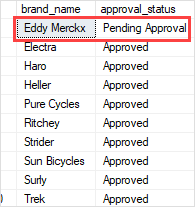
The following statement shows the contents of the production.brand_approvals table:
SELECT
	*
FROM
	production.brand_approvals;Code language: SQL (Structured Query Language) (sql)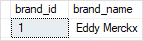
In this tutorial, you have learned about SQL Server INSTEAD OF trigger and how to create an INSTEAD OF trigger for inserting data into an underlying table via a view.

